The American West has spent more than a century building infrastructure to capture, store and move scarce water.
Dams hold back rivers. Reservoirs store snowmelt. Aqueducts move water hundreds of miles. Increasingly, utilities and water agencies are also looking underground, using managed aquifer recharge and water banking to save water for the dry years that inevitably follow the wet ones.
In Utah, researchers are exploring another approach.
They are putting beavers back to work.
Among them is Nate Norman, lead biologist with Utah State University’s Beaver Ecology and Relocation Collaborative. Norman and his colleagues work with landowners, wildlife agencies and land managers to determine where people can coexist with beavers and where animals causing problems in one location might instead contribute to stream restoration somewhere else.
It sounds almost whimsical until you consider what a beaver actually does.
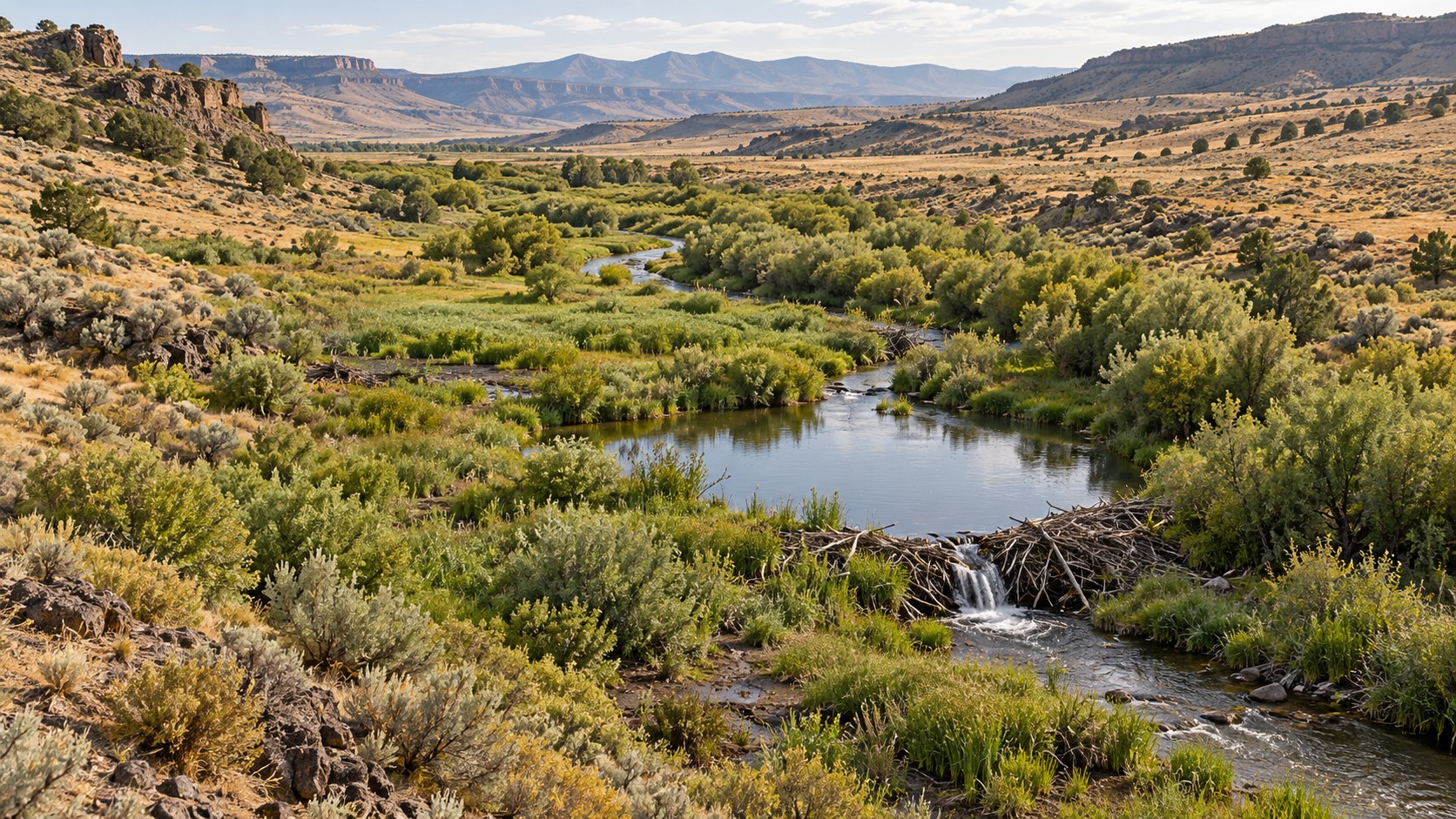
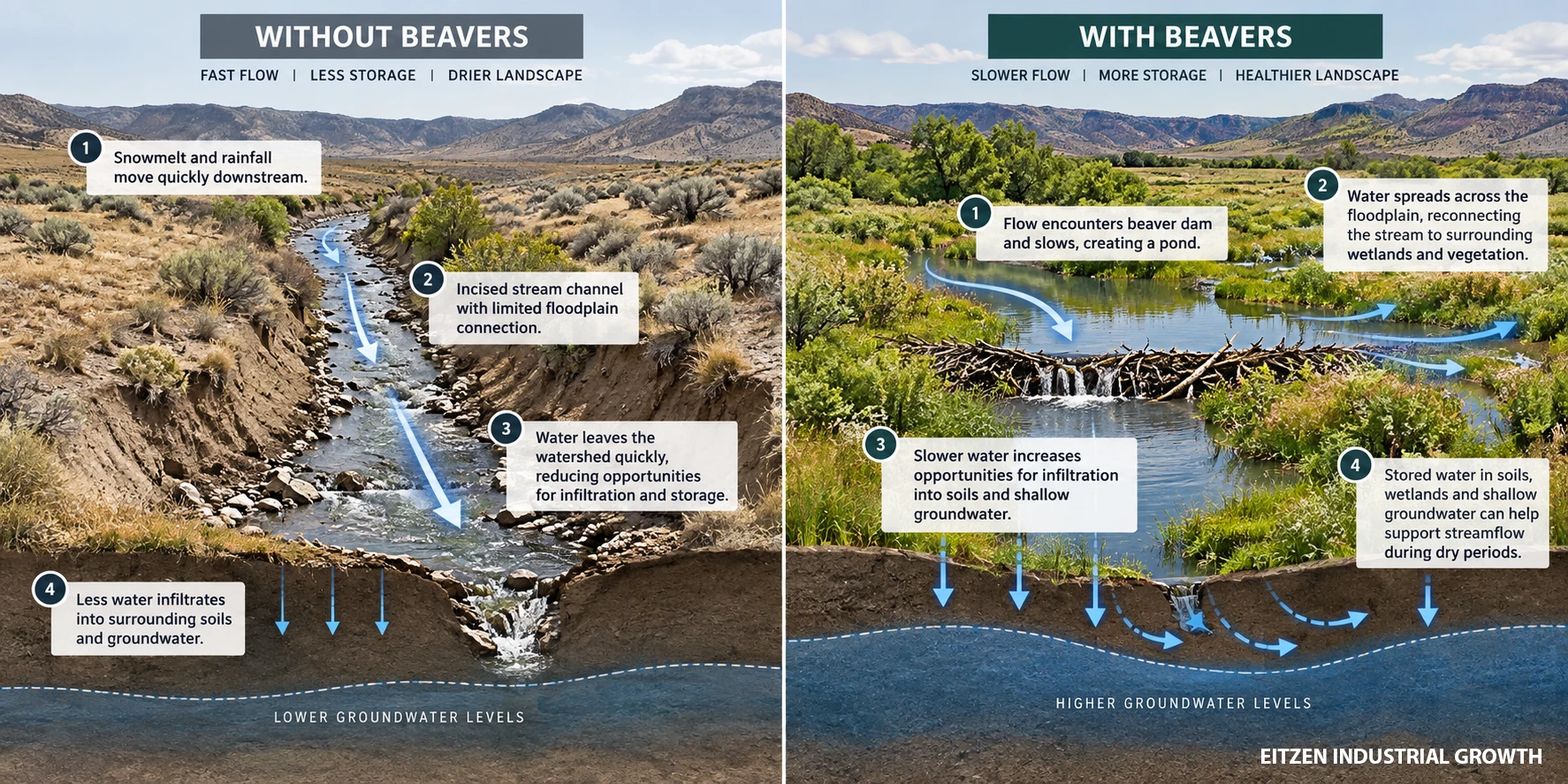
Give a beaver a suitable stream and it begins engineering. It cuts vegetation, moves material and constructs dams. Those dams slow flowing water, spread it laterally across floodplains and create ponds and wetlands. Water that might otherwise move rapidly downstream has more opportunity to infiltrate surrounding soils and interact with shallow groundwater.
And when a dam leaks or breaks, the engineer comes back to work.
For a region confronting increasingly difficult questions about how to retain scarce water, that behaviour is attracting serious attention.
A drought problem is also a storage problem
The scale of the water challenge facing the West is difficult to ignore.
As of June 16, 2026, 90.9% of Arizona, Colorado, Nevada, New Mexico and Utah was experiencing drought, according to the National Integrated Drought Information System. The 2025–26 winter also produced record-low seasonal snowpack across parts of the West, with April 1 snow-water equivalent falling 32% to 53% below the previous record low in the SNOTEL era.
That matters because mountain snowpack is itself an enormous water-storage system.
Snow accumulates through the winter and releases water gradually as temperatures rise. When there is less snow, or when it melts earlier, that natural storage mechanism becomes less reliable.
Researchers with the U.S. Geological Survey are now examining precisely this problem in northern New Mexico. In the Jemez Mountains, USGS reports that the average date on which snow cover disappears is approximately 40 days earlier than it was in 1980. Streams that depend heavily on mountain snow can consequently experience very low flows or run dry during summer.
So drought resilience is not exclusively about finding more water.
It is also about asking a deceptively simple question:
How do we keep the water we do receive in the landscape longer?
That is where beavers become interesting.
What happens when you slow the water down?
A conventional drainage mindset often emphasizes moving water efficiently through a system.
Beaver engineering tends to do almost the opposite.
A dam introduces friction and complexity. Water backs up. Flow slows. Some water spreads into adjacent areas. Sediment accumulates. Vegetation can establish in wetter soils. The stream becomes connected to a larger wetland and floodplain system.
Most importantly for drought resilience, slowing water can increase the opportunity for infiltration.
The USGS is currently studying beaver dam analogues in northern New Mexico as a nature-based response to declining snowpack. These human-built structures mimic some of the hydraulic effects of natural beaver dams.
The premise is straightforward: slowing runoff can increase infiltration into shallow groundwater reservoirs. That groundwater can later contribute to stream base flow, potentially helping streams retain water further into the summer and during drought.
It is a different way of thinking about water storage.
Instead of concentrating all storage behind a single large structure, some water is retained across the landscape in soils, shallow groundwater, wetlands and ponds.
The landscape itself becomes part of the storage system.
Humans have started building like beavers
One indication of how seriously researchers take beaver hydrology is that humans have begun copying it.
Beaver dam analogues, usually called BDAs, are relatively simple structures constructed across streams using materials such as wooden posts, branches and other natural materials.
Their purpose is not necessarily to create a permanent artificial dam.
It is to restart processes that have disappeared from degraded streams.
Slow the water. Encourage sediment deposition. Reconnect a stream with its floodplain. Raise local water levels. Encourage riparian vegetation.
And, in some projects, create conditions in which actual beavers can eventually take over.
Recent work in California provides a striking example. In September 2026, NOAA Fisheries reported on restoration work in Sugar Creek in the Klamath Basin, where researchers and watershed partners began installing inexpensive structures made from wooden posts and willow branches in 2014.
The creek had historically suffered from low summer flows and sometimes ran dry.
The structures helped restore slow-water wetland habitat. Research published in 2026 found increased habitat capacity for threatened coho salmon, improved juvenile survival and increased adult returns. The restored population was also less affected by severe drought than populations in neighbouring unrestored systems.
That doesn’t mean every degraded stream should be filled with artificial dams.
It demonstrates something more important.
Restoring the physical processes associated with beaver-created wetlands can change how a watershed responds to water scarcity.
But why not let the beavers do it?
That question is being tested in Utah.
Utah State University’s Beaver Ecology and Relocation Collaborative works with beavers that have become a problem in one location and looks for opportunities to either help landowners coexist with them or relocate appropriate animals.
Nate Norman, the program’s lead biologist, works with landowners, wildlife agencies and land managers to identify potential release sites and develop relocation strategies. Utah’s Watershed Restoration Initiative describes the program as an ongoing effort to support stream and riparian restoration by translocating and tracking beavers in watersheds where low-tech process-based restoration has occurred or is planned.
There is an appealing efficiency to the idea.
A human restoration crew can build a structure.
A beaver can build one, inspect it, modify it and repair it.
Norman has described the potential advantage plainly: if relocated beavers remain at an appropriate site, they can engineer the stream more effectively and at substantially lower cost than hiring people to perform comparable work.
This is where the idea of the beaver as a keystone species and an ecosystem engineer becomes more than ecological terminology.
The animal is actively changing the physical environment around it.
And those changes affect far more than the beaver.
The desert-river experiment
Some of the most interesting work has taken place on Utah’s Price and San Rafael rivers.
Researchers have studied whether nuisance beavers captured elsewhere could be relocated into degraded desert river systems and contribute to restoration.
The concept is compelling: rather than killing an animal that is causing flooding or other problems in one location, move it to a watershed where beaver activity may be beneficial.
Researchers observed substantially more river reaches containing dams after translocations than before them, although they could not definitively attribute the new dams to individual relocated animals.
But the experiment also exposed one of the most important realities about nature-based infrastructure.
Nature doesn’t always follow the engineering plan.
The results also show why beaver-assisted restoration requires more than simply moving animals into a watershed. In the first two years of the Utah experiment, researchers translocated 47 beavers. Survival among the translocated animals was just under 40%, compared with roughly 80% among established resident beavers. Researchers nevertheless observed evidence of new dam building and maintenance at the restoration sites, with adults more likely than younger animals to remain near the intended locations.
Relocated beavers moved extensively. Some left the intended restoration area. Predation was significant.
A subsequent Utah State study tested whether installing beaver dam analogues before releasing beavers would improve relocation success.
Researchers installed 70 BDAs and subsequently translocated 73 tagged beavers. Apparent survival, which incorporated both survival and remaining within the study area, was similar before and after the structures were installed. By the end of data collection, no translocated beavers remained alive within the study area.
That is an important result.
It is also exactly why the beaver story is more interesting than a simple environmental success story.
Beavers are not a drought silver bullet
Put a beaver in the wrong watershed and it does not become an instant restoration program.
Suitable habitat matters. Vegetation matters. Stream conditions matter. Existing beaver populations matter. Predators matter. Landowners matter.
And sometimes beavers create very real problems.
They can flood roads and agricultural land, block culverts, damage trees and alter property in places where those changes are unwelcome. Norman himself has emphasized that beavers can be a genuine nuisance when they occupy the wrong locations.
That is why modern beaver restoration increasingly includes coexistence strategies, careful site selection and monitoring rather than simply moving animals from one watershed to another.
Utah’s current program reflects that broader approach. Its 2026 work included non-lethal responses to human-beaver conflicts alongside relocation, monitoring and stream restoration. Utah has continued the program into fiscal 2027.
The lesson is not that natural systems eliminate the need for engineering.
It is that natural processes themselves can become part of the engineering toolkit.
A different kind of water bank
That idea becomes especially interesting when considered alongside the growing discussion about water banking in the American West.
Traditional water storage is easy to visualize.
A reservoir stores water behind a dam.
An aquifer recharge project intentionally moves water underground.
A water bank creates institutional and physical mechanisms for storing water now so that it can be used later.
Beaver-created wetlands operate at an entirely different scale, but there is a conceptual similarity.
They slow water that might otherwise leave a landscape quickly and create opportunities for some of that water to remain within soils, wetlands and shallow groundwater.
It would be misleading to equate a beaver pond with a municipal reservoir or a managed aquifer recharge program. The volumes, reliability, controllability and purposes are entirely different.
But at the watershed scale, thousands of small interventions can matter.
Research into what scientists call natural infrastructure in dryland streams has found that structures created either naturally or by people can restore wetland functions in water-scarce riparian environments. Researchers increasingly see these systems as part of a broader strategy for strengthening climate resilience in dry landscapes.
Perhaps the better analogy, then, is not a reservoir.
It is distributed infrastructure.
Water storage that happens to be alive
Modern infrastructure is increasingly distributed.
Energy systems combine centralized generation with distributed solar, batteries and demand management.
Stormwater systems increasingly supplement large pipes with green infrastructure that captures rainfall where it falls.
Water resilience may increasingly follow a similar model.
Large reservoirs, conveyance systems, groundwater recharge and water banking will remain essential to communities across the West.
But those systems can coexist with thousands of smaller interventions designed to keep water in watersheds longer.
Wetland restoration.
Floodplain reconnection.
Beaver dam analogues.
And, where conditions are right, beavers themselves.
There may even be benefits beyond drought.
Research on major Rocky Mountain wildfires found that riparian areas containing beaver dams experienced significantly lower burn severity than comparable river corridors without dams, suggesting that wetter beaver-modified landscapes can provide pockets of wildfire resilience as well.
Again, none of this makes the beaver a substitute for engineered water infrastructure.
It makes the beaver part of a larger conversation about what infrastructure can be.
Engineering with the landscape, not just through it
For generations, much of water engineering has understandably focused on controlling water.
Capture it.
Store it.
Move it.
Drain it.
Protect communities from it.
Deliver it where it is needed.
Those capabilities made cities, agriculture and industry across the American West possible.
But increasing water scarcity is forcing another question.
Where can we work with natural systems to complement the infrastructure we have already built?
Beavers offer one surprisingly sophisticated answer.
They slow water. They create wetlands. They alter streams. They maintain their own structures. And in the right landscapes, those changes can help keep water around longer.
Sometimes humans mimic them with wooden posts and willow branches.
Sometimes researchers relocate the engineers themselves.
Neither approach will solve drought in the American West.
But that may be the wrong standard.
Drought resilience will not come from one dam, one aquifer, one technology or one species. It will come from combining solutions at multiple scales and recognizing that some of the most effective water infrastructure may not look like infrastructure at all.
After more than a century spent engineering the West’s water, perhaps part of the next century will involve learning when to let nature engineer alongside us.
Norvin Eitzen
Founder, Eitzen Industrial Growth. Norvin leads strategy, client relationships, technical marketing and delivery coordination for industrial and infrastructure companies.